
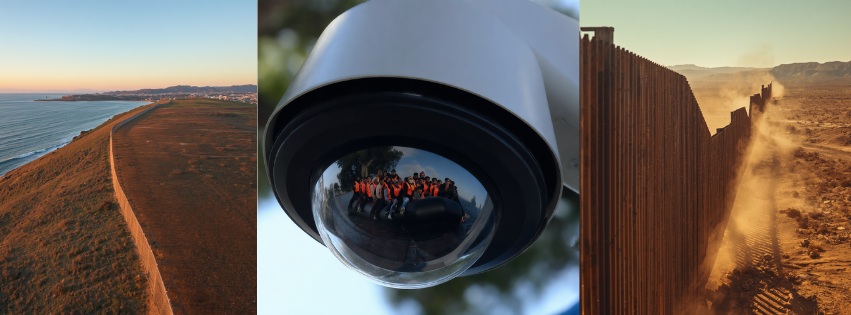
Europe’s borders are no longer controlled by fences, patrol cars and border guards alone. Increasingly, they are monitored by drones, satellites, biometric databases, artificial intelligence, facial-recognition systems, sensors and vast networks of data.
Behind this expanding infrastructure is a reality that receives far less attention: border enforcement has become a business.
As European governments invest more money into preventing, detecting and controlling irregular migration, private technology and security companies are being paid to provide the tools that make this system possible. The migrants attempting to cross Europe’s borders may be fleeing poverty, conflict, persecution or instability, but their movements have also become the basis for an expanding technological market.
The issue is not that technology companies are responsible for migration. Nor is it accurate to claim that companies deliberately create migration in order to profit from it. The more important question is what happens when governments respond to migration primarily through surveillance and enforcement—and private companies are paid to build and maintain that response.
This does not mean that technology companies are responsible for migration, or that they are deliberately encouraging people to cross European borders so that they can make money. The relationship is more complicated. The issue is that irregular migration has become a significant political priority, and governments are spending substantial amounts of public money responding to it. Whenever governments identify a problem that requires large-scale technological solutions, private companies are positioned to provide those solutions. In this case, the problem is migration, and the products being sold include the technologies used to control it.
The European Union has invested billions of euros into strengthening its external borders. Funding is available for surveillance equipment, information systems, biometric identification, border-control infrastructure and other technologies intended to prevent and detect irregular crossings. Agencies such as Frontex and eu-LISA play increasingly important roles in managing the technological infrastructure surrounding Europe’s borders, while private companies compete for contracts to supply the equipment and services required to operate these systems.
Also Read: Undocumented Labour and Morocco’s Agricultural Dependency
This has created a substantial commercial market. Companies involved in aerospace, defence, information technology, biometrics and surveillance can benefit from government spending on border security. Research into European border agencies has identified companies such as Airbus, IDEMIA, Elbit and Sopra Steria in connection with different areas of border technology and data infrastructure. In 2025, for example, a European Parliament document reported that Frontex had entered into a framework contract worth approximately €184 million for long-range drones involving Airbus and Leonardo.
The important point is that these purchases do not necessarily represent a one-time transaction. Border technology requires continuous investment. Drones need maintenance and operators. Databases require storage and software development. Biometric systems need to be updated and integrated with other databases. Surveillance systems become outdated and have to be replaced or upgraded. As governments seek to monitor larger areas and identify migrants earlier in their journeys, the technological requirements become increasingly complex.
In this sense, the border can become a self-perpetuating market. When governments believe that existing surveillance is insufficient, they invest in additional technology. When migrants change their routes in response to increased enforcement, governments seek new methods of detection. When the amount of information becomes too large for human authorities to process, automated systems and artificial intelligence become more attractive. Each development can create demand for another layer of technology.
Also Read: Europe’s Outsourced Borders
There is also an important distinction between the people who experience the border and the companies that build the infrastructure around it. For migrants, increased surveillance can mean greater difficulty reaching European territory and, in some cases, interception before they ever reach their destination. For governments, the same technology can be presented as a tool for border management and security. For companies, however, the system represents a market for products and services.
That creates a difficult question about incentives. A technology company does not necessarily need migration to increase in order to profit. It needs governments to continue believing that migration requires technological intervention. As long as governments continue allocating money toward surveillance, identification and border enforcement, companies capable of supplying those technologies have an economic reason to participate in the market.
This is particularly significant because European migration policy increasingly extends beyond the physical boundary of Europe. Surveillance can take place far from the border itself. Drones can monitor maritime routes. Satellites can observe movement across large areas. Information can be exchanged between European agencies and countries outside the EU. Biometric databases can allow authorities to identify people across different stages of the migration and asylum process. The border is therefore becoming less of a line on a map and more of a technological network extending across countries and continents.
Also Read: Are There Any Apps or Platforms That Track Incidents of Illegal Pushbacks?
The expansion of this system also raises questions about the role of migrants within it. A person attempting to cross a border can become a collection of data: a face captured by a camera, fingerprints stored in a database, a location detected by surveillance equipment, or a movement classified according to an algorithm. The individual circumstances behind that journey—poverty, war, persecution, family separation or the absence of legal routes—can disappear behind the technological language of detection and risk.
This is one of the reasons the growth of the border-security industry deserves greater public scrutiny. The question should not simply be whether a particular drone, database or artificial-intelligence system works. It should also be whether its use is proportionate, whether people’s rights are protected, how the information is collected and shared, and what happens when the technology contributes to an incorrect identification or an unlawful interception.
There is also a broader question about where public resources are being directed. European governments spend enormous amounts of money attempting to prevent irregular migration, while immigration pathways remain limited for many people seeking protection or economic opportunity. As the political emphasis remains on deterrence and enforcement, more resources can flow toward the infrastructure designed to keep people out rather than toward systems designed to provide safe and legal alternatives.
This does not mean that every company involved in border technology is acting illegally or that every use of surveillance technology is inherently wrong. Governments have legitimate responsibilities to manage their borders, and technology can have legitimate uses, including search-and-rescue operations and identifying people who may need assistance. The concern arises when technological expansion becomes the default response to a fundamentally political and humanitarian problem.
Ultimately, Europe’s migration system is not only about the people attempting to cross its borders. It is also about the institutions, governments and businesses that have developed around controlling those movements. Billions of euros are being invested in the infrastructure required to detect, identify and prevent migration, creating a substantial industry whose growth is closely connected to government decisions about how migration should be managed.
That is why the question of who profits from Europe’s borders deserves to be part of the migration debate. Migrants may be risking their lives to cross those borders, while governments justify increasingly sophisticated systems to stop them, and private companies are paid to build those systems. The people crossing the border experience the consequences, governments control the policy, and companies can benefit financially from implementing it.
The issue is therefore bigger than whether Europe should have stronger or weaker borders. It is about what happens when human movement becomes the justification for an expanding technological infrastructure—and when controlling that movement becomes a business opportunity in its own right.