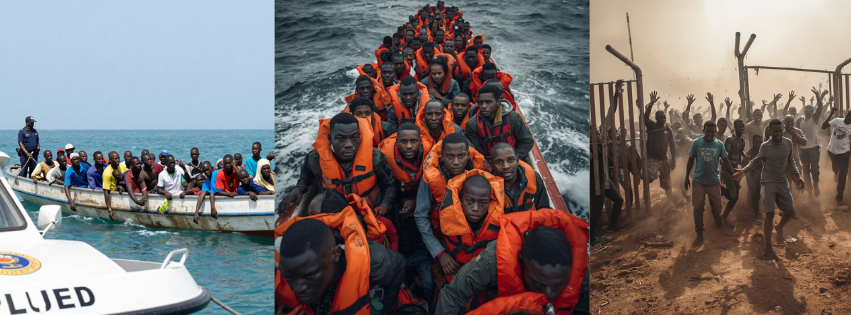
At Europe’s edge, the border is no longer where most people think it is. It does not sit only in places like Ceuta or Melilla, nor does it begin at the checkpoints of Greece or Italy. Increasingly, Europe’s border is being pushed outward — into North African cities, desert crossings, detention centres, and systems of coordination that rarely appear in public debate.
What is unfolding is a shift in global migration governance, where control over movement is no longer contained within national territory but distributed across partnerships, technologies, and external agreements.c pressures.
Over the past two decades, EU migration policy has increasingly relied on what is commonly called the externalization of borders. In practice, this means migration control is extended far beyond Europe’s physical territory, often through funding, training, and cooperation agreements with transit countries. This system has had a direct impact on North Africa migration routes, which have become heavily monitored and increasingly restricted. Instead of reaching European soil, many people are intercepted long before departure or stranded in transit zones. The result is a form of migration flow control that operates far from public visibility.
ALSO READ: Are there any apps or platforms that track incidents of illegal pushbacks?
Invisible borders in practice
These shifts have created what many describe as invisible borders — not walls or fences, but systems of surveillance, databases, patrol networks, and cross-border coordination. Through border management cooperation, European states work with external partners to manage movement across irregular migration routes, often outside of public scrutiny. The effect is not simply restriction at the border, but a layered system that moves enforcement outward and disperses responsibility.
There is also a psychological dimension to this shift. When enforcement is moved outside of Europe, it becomes easier for European societies to disconnect from its impact. The visibility of migration control decreases, even as its reach expands. This creates a gap between perception and reality: migration may appear “managed” or “contained,” but the actual mechanisms are operating elsewhere, often under less scrutiny.
ALSO READ: Why pushbacks are illegal
When responsibility moves too
As borders expand outward, so does accountability. This is where concepts like border displacement and migration policy displacement become important. Responsibility for managing migration is no longer clearly located within one jurisdiction. Instead, it is distributed across multiple actors — EU institutions, national governments, and external partners. Within this structure, migration becomes harder to regulate transparently, especially when framed through ongoing migration crisis management narratives.
One of the most controversial outcomes of this system is the continued use of pushback operations — the forced return of individuals without access to asylum procedures or legal review. These practices are often justified as emergency responses, part of broader migration crisis management strategies. But human rights organisations have repeatedly raised concerns about the lack of accountability and oversight. In discussions around human rights at borders, pushbacks remain one of the most contested and documented practices.
A system built on distance
What emerges is not a single system, but a network — one that stretches across continents. From North Africa migration routes to European policy centres, from detention facilities to coordination systems, border control has become increasingly remote and difficult to trace. This is the defining feature of today’s global migration governance: control without proximity, enforcement without visibility, and responsibility without a clear centre.
At the same time, this externalization does not reduce the forces driving migration. Conflicts, economic instability, climate pressures, and inequality remain unchanged. Instead of addressing these root causes, the system focuses on redirecting movement. The result is not a resolution, but a redistribution of pressure—pushing it further along migration routes and onto countries that are less equipped to carry it. This raises difficult questions about responsibility. If a system is designed through European policy and funding, but implemented outside European jurisdiction, who is accountable for its outcomes? And how do human rights protections apply when enforcement takes place in spaces that sit outside the legal and political frameworks where those protections are normally enforced?
What is emerging is not simply a stricter border policy, but a reconfiguration of the border itself. It is becoming mobile, layered, and outsourced. And as it moves, so do the consequences—less visible to those who design the system, but deeply real for those who move through it.
SIGN THE PETITION TO: Stop Illegal Pushbacks at European Borders